
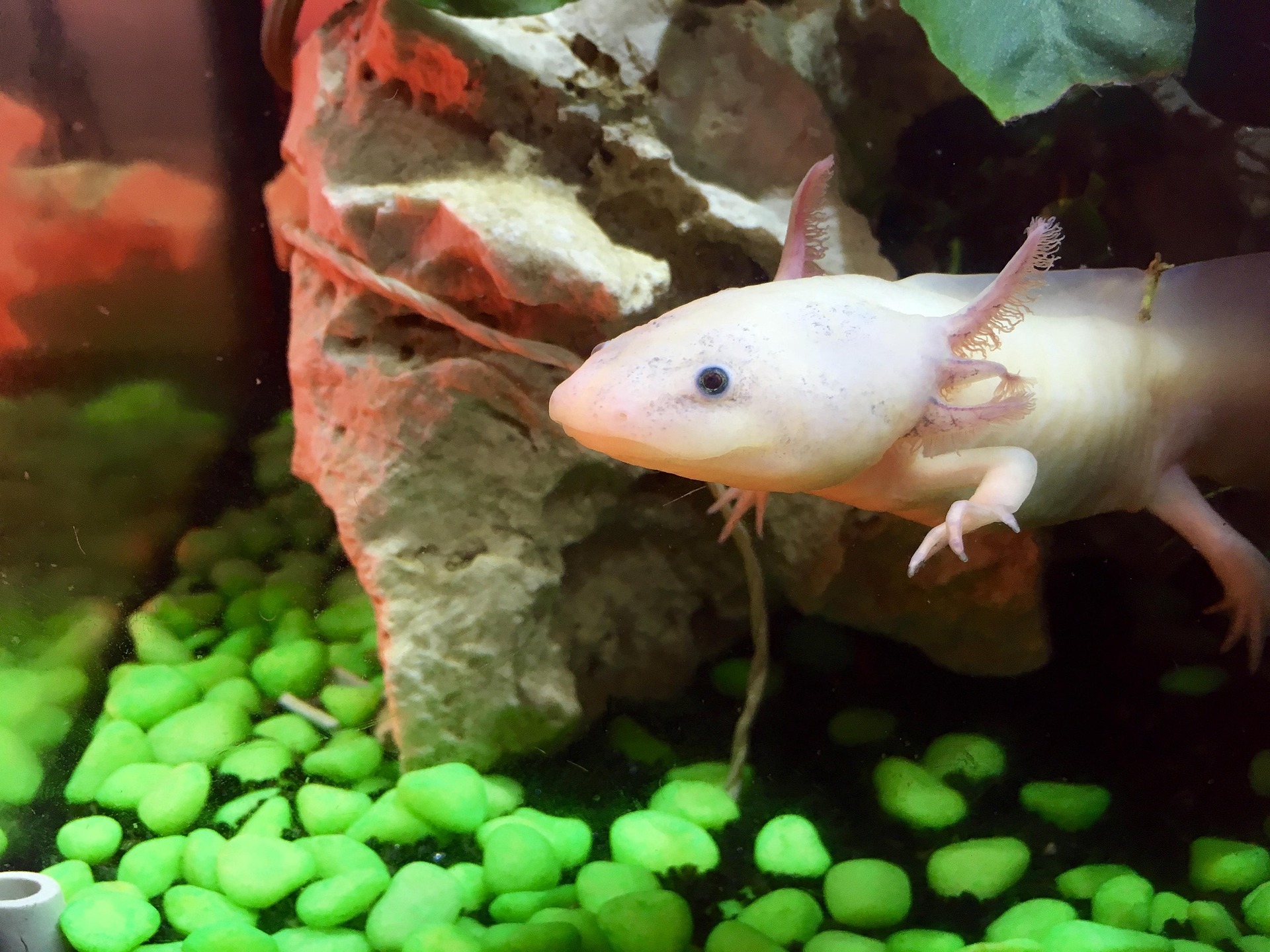
If you’ve spent any time herping or even scrolling reptile content online, you’ve probably seen the goofy grin and feathery gills of an axolotl. It looks like something halfway between a cartoon dragon and an alien tadpole. The big question people always ask is: Is an axolotl actually a salamander… or is it something completely different?
Short answer? Yes. An axolotl is 100% a salamander. Long answer? It’s one of the most biologically fascinating salamanders on the planet.
What Is an Axolotl, Scientifically?
The axolotl’s scientific name is Ambystoma mexicanum. It belongs to the mole salamander family (Ambystomatidae), the same family as the tiger salamanders you might encounter during field herping in parts of the United States.
That means taxonomically, there’s no debate:
- Class: Amphibia
- Order: Caudata (salamanders)
- Family: Ambystomatidae
- Species: Ambystoma mexicanum
So scientifically speaking, it is absolutely a salamander. But here’s where things get interesting.
Why Doesn’t It Look Like Other Salamanders?
Most salamanders go through a life cycle that looks like this:
- Egg (laid in water)
- Aquatic larva with gills
- Metamorphosis
- Terrestrial adult with lungs
Axolotls skip step 3.
They remain in their larval form for their entire lives, a condition called neoteny. That means:
- They keep their external gills.
- They stay fully aquatic.
- They don’t develop the typical adult salamander body form.
- Yet they still become sexually mature and reproduce.
That’s the biological twist that makes them so unique. While most salamanders eventually leave the water, axolotls basically say, “I’m good here,” and stay aquatic forever.
Where Do Axolotls Come From?
Axolotls are native to the lake and canal systems of Xochimilco in Mexico City. Historically, they lived in high-altitude freshwater lakes. Today, due to urban expansion, pollution, and invasive species, they survive in only small, fragmented canal habitats. In the wild, they’re critically endangered. Which is wild to think about, considering how common they are in the pet trade.
The Regeneration Superpower
Axolotls aren’t just salamanders, they’re biological legends.
They can regenerate:
- Entire limbs
- Spinal cord tissue
- Parts of their brain
- Heart tissue
And they don’t just grow scar tissue, they regrow fully functional structures. That’s one reason they’re heavily studied in scientific research. Understanding how axolotls regenerate tissue could potentially impact human medicine in the future. For a salamander, that’s next-level.
Can Axolotls Ever Turn Into “Normal” Salamanders?
Technically, yes, but not naturally. Under certain hormonal treatments (thyroid hormone exposure), axolotls can be forced to undergo metamorphosis and develop into a more typical salamander form similar to other members of the Ambystoma genus.
However:
- It’s stressful for the animal.
- It shortens lifespan.
- It’s not something responsible keepers attempt casually.
In the wild, they almost never metamorphose. Their neotenic state is their natural, evolved condition, not an accident.
Axolotls vs. Other Salamanders in the Field
You won’t stumble across an axolotl during typical North American field herping trips unless you’re in a very specific part of Mexico.
But you might encounter:
- Tiger salamanders
- Spotted salamanders
- Red-backed salamanders
An axolotl is not a frog. Not a fish. Not a reptile. It is a fully legitimate salamander that simply never grows up in the traditional sense.
0 Comments