
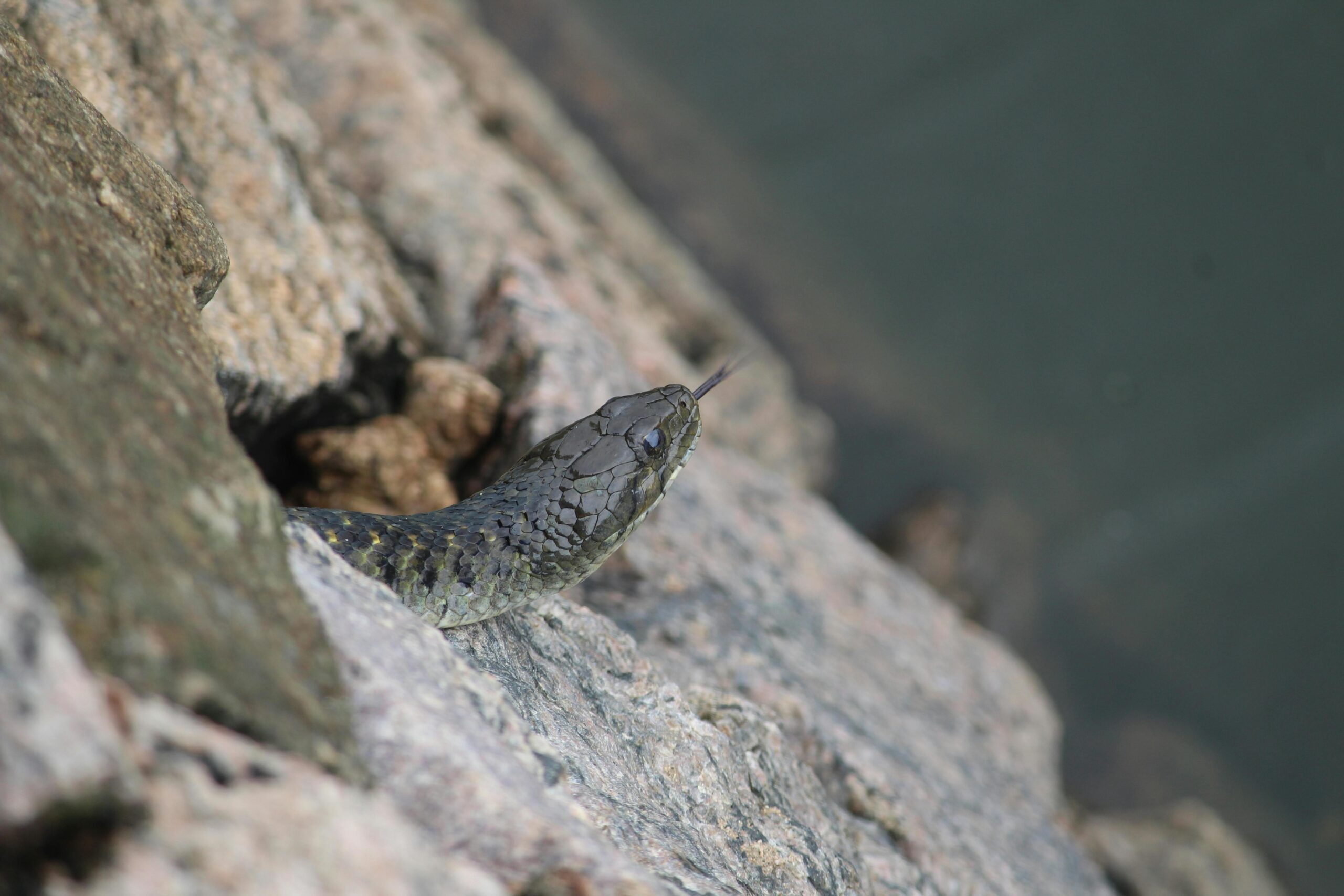
When you’re out herping, one of the most fascinating things to witness, if you’re lucky enough, is a snake or lizard flicking its tongue or rubbing against a rock in a very deliberate way. To the untrained eye, it might just seem like quirky behavior. But dig deeper, and you’ll find a world built not on sound or sight, but on scent. For reptiles and amphibians, smell is more than just a way to find food, it’s a full-blown communication system that governs everything from territory and courtship to survival.
Tongue Flicks and Jacobson’s Organs: How Reptiles Smell
Let’s start with the basics. Unlike mammals, most reptiles don’t rely heavily on nostrils alone for smelling. Instead, they use a specialized organ called the Jacobson’s organ, or the vomeronasal organ, located in the roof of their mouth.
When a snake or lizard flicks its tongue, it’s collecting chemical particles from the air, ground, or even water. Once the tongue retracts, those particles are deposited directly into the Jacobson’s organ, where they’re analyzed. This process helps the animal determine not only what’s nearby, but also who, including potential mates, rivals, or prey.
Field herping veterans know this behavior all too well. You may have seen a garter snake pause mid-movement, tongue rapidly flicking, trying to “see” the world through scent. That’s not just curiosity, it’s a strategic decoding of invisible trails left behind by others.
Amphibians and Their Moist-Skin Chemistry
While amphibians don’t have the same tongue-flicking abilities as snakes or lizards, they’ve got their own chemical communication tricks. Frogs, toads, and salamanders secrete pheromones through their skin or specialized glands. These chemical messages are critical for attracting mates or warning others off a territory.
One classic example is the male red-backed salamander. During courtship, it uses a chin gland to rub pheromones onto the female’s body, a chemical love letter that helps convince her to stick around for reproduction.
Some amphibians, like caecilians, even have tentacle-like chemosensory organs that help them navigate underground in total darkness. For these often-overlooked herps, scent isn’t just helpful, it’s survival.
Scent Marking: The Herp Version of a Status Update
Lizards are known for scent marking just as much as mammals. Male iguanas and anoles, for instance, use femoral pores on the inside of their thighs to secrete waxy substances that mark territory. These markings tell other males to back off, and can let females know who the dominant male is in the area.
If you’re field herping in the right season, you might catch a male lizard doing a little territorial push-up display near one of these scent marks. While it looks like a flex (literally), it’s also a visual reinforcement of a chemical boundary.
Courtship and Reproduction: The Scent of Love
Scent plays a huge role in reptile mating. During breeding season, many snakes rely entirely on pheromone trails left by receptive females. Males can follow these trails for hours, even days, until they find the female. This is especially true for species like garter snakes, where mating balls form around a single female attracting dozens of eager males.
In some species, males can even tell the difference between a female that’s already mated and one that hasn’t, just from the chemical signature she leaves behind.
Survival Through Scent: Who’s Been Here?
For both predators and prey, scent helps reptiles and amphibians make quick survival decisions. A snake might avoid an area where a larger predator recently passed. A lizard may freeze when it picks up the scent of a bird or mammal. Chemical cues linger long after a visual threat is gone.
Some prey species even mimic scent to avoid predation. The Eastern Hognose Snake, known for its theatrical death displays, also releases a foul-smelling musk to convince predators it’s not worth eating. It’s the herp version of playing dead, and stinking to sell it.
For Herpers: What This Means in the Field
Understanding how herps use scent can elevate your field herping game. Knowing that some reptiles are more active after a rain, not just because it’s cooler, but because scent trails are fresher, can help you time your outings better.
It also reminds us to be cautious and respectful. Your boots, your gear, even your own scent can influence how herps behave around you. And if you’ve ever used snake hooks or traps for research or observation, it’s smart to clean them thoroughly, herps can absolutely smell where you’ve been.
0 Comments