
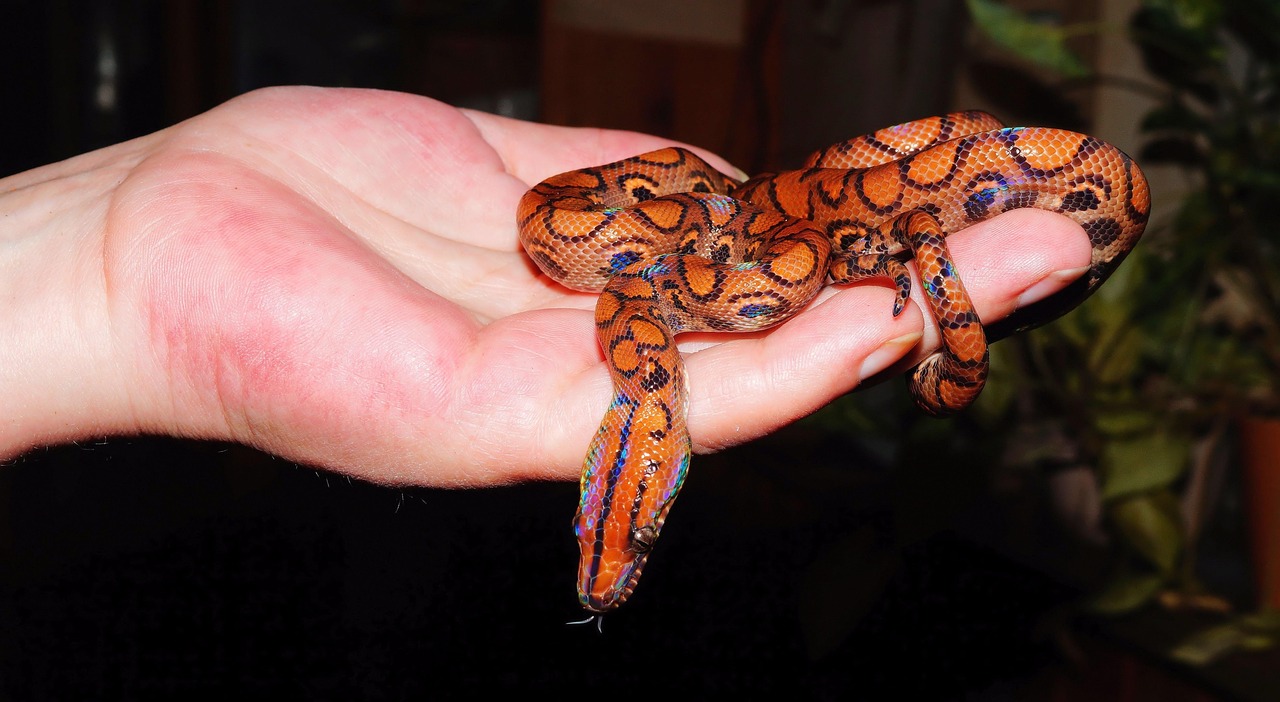
If you’ve spent any time herping, you’ve probably had that moment. You lift a log, shine your light just right, and instead of just seeing scales, you see color. Not bold bands or bright reds, but a subtle rainbow sheen sliding across the body of a snake as it moves. It almost looks fake. Like oil on water. And then it shifts, disappears, and you’re left wondering if you imagined it. Some snakes are iridescent, and it’s one of the most underrated traits in the reptile world.
What Does “Iridescent” Actually Mean?
Iridescence isn’t about pigment. It’s not like the red of a coral snake or the green of a vine snake. Instead, it’s about light interacting with microscopic structures on the surface of the scales.
When light hits certain types of smooth, tightly layered scales, it bends and reflects in different directions. That reflection splits into different wavelengths, what we see as shifting rainbow colors.
So the snake isn’t technically rainbow-colored. The color changes depending on:
- The angle of the light
- The angle you’re viewing it from
- The smoothness and structure of its scales
The Rainbow Boa (Epicrates cenchria)
The rainbow boa is the snake most people think of when they hear “iridescent.” And for good reason. In direct sunlight, their scales explode with color, blues, purples, greens, all shimmering across a reddish-brown base.
But here’s the key: in dull lighting, they look almost plain.
That’s what makes seeing one in the wild such a moment. When you catch that sheen under a headlamp during field herping, it feels like discovering something hidden.
The Sunbeam Snake (Xenopeltis)
If the rainbow boa is flashy, the sunbeam snake is pure oil-slick shine. Native to Southeast Asia, this burrowing species has incredibly smooth scales. When sunlight hits them, the entire body reflects a metallic rainbow. It almost looks artificial, like it’s been polished. But here’s what’s interesting: sunbeam snakes spend much of their time underground. That shimmer isn’t primarily for display.
Why Evolve Iridescence at All?
There are a few solid theories.
- Structural Strength and Scale Function
The same smooth, tightly packed scale structure that creates iridescence may also:
- Improve burrowing ability
- Reduce friction
- Increase durability
In other words, the shine might be a side effect of scales built for performance.
- Camouflage Through Confusion
This sounds counterintuitive. Wouldn’t shimmer make them more visible? Not necessarily.
In filtered forest light, where sunbeams break through leaves, the shifting colors can actually disrupt a predator’s ability to track the snake’s outline. Instead of a clean silhouette, you get flashes of broken light. That visual confusion can buy precious seconds.
- Moisture Retention
Some researchers suggest the microstructure that creates iridescence may help with water management on the skin, especially in humid environments. It’s not fully confirmed, but it’s being studied.
It’s More Common Than You Think
While rainbow boas and sunbeam snakes are famous for it, subtle iridescence can be found in many species, especially dark-colored snakes. Black rat snakes, indigo snakes, even some kingsnakes can show a faint blue or purple sheen when light hits them right.
When you slow down and really look at a snake instead of just identifying it and moving on, you start noticing those details. The way the scales reflect under your headlamp. The way the body changes as it moves. That’s the difference between seeing a snake and studying it.
0 Comments